

Under the Bridge: Is it Photography?
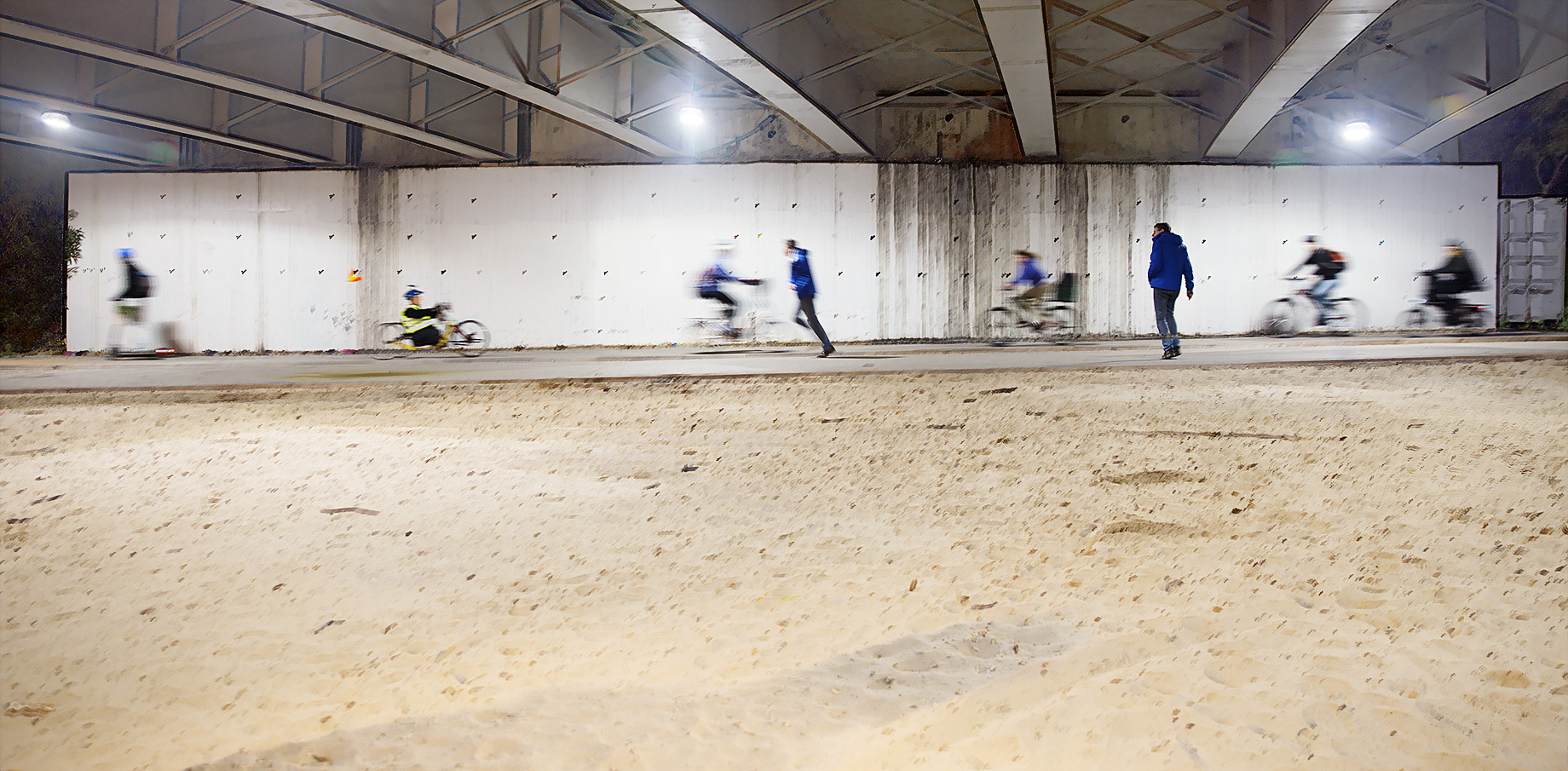
My previous post, Impressionism Photography, presents a photograph of an iris taken 10 times on a tripod and blended together. There was no cut-and-paste, and there was no change in the position of any pixels in any of these photographs. It was simply 10 images layered on top of one another in Photoshop, in the exact order in which they were taken, blended in a certain manner, and then lightened a bit with a curve at the end.
Under the Bridge was treated almost identically. It was made from 11 photographs that I carefully chose from more than 40 that I took from the same position on a tripod over 11 minutes. They were layered and blended in the same manner as the iris photograph, except that here, in some of the photos, I removed an unwanted subject by masking a small section of each photograph. Then, with a single additional step and a gradient mask, I added light to the darker ceiling. For a better composition, I also cropped the top of the image.
For the sake of this post, I’ll skip the discussion of whether or not this is art. I do, however, ask the question: Is it photography?
It may look like I’m stretching the limits, and maybe I am. In the dark-brown iris photograph, with moving grass in the background, the blended image may seem more natural despite the impressionist look it creates—particularly when you look closely at the details. In Under the Bridge, however, using almost the same technique, we get something different. Here, new subjects are clearly added, yet the technique used is the same—except that the images layered and added in each blended image appear to be on a different scale. More importantly, in “Under the Bridge,” each photograph has a distinct and stronger impact on the image’s meaning than each of the iris photographs.
Close-up

In a close-up view (1:1), one can see how the same blending procedure creates different results. Here, in some parts of the image—particularly on the sand—the “impressionism” look is still there, albeit much less obvious. In other parts of the photograph, it may appear as though wide brushstrokes were used; however, none of them was a Photoshop action. These brushstrokes are the result of a highly conventional photographic procedure: a slow shutter speed.
Is this photography?
Note that I do not ask whether this is a photograph, because I’ve already told you this is a blend of 11 individual photographs. Hence the more precise question: Is this photography?
If you suggest that my dark-brown iris is photography, then it would be difficult to argue that Under the Bridge is not. The technique used to make them is very similar, except for the one major difference I mentioned: masking one person in some of the photographs (layers). Images were added by blending, not by complicated masking techniques or by moving, cutting, and pasting any of the characters. Using a remote release, I was even able to include myself twice in the final image, as well as my shadow on the sand in the foreground.
Jerry Uelsmann
Even in the enlightened days of the darkroom, many photographers layered negatives to create composite images. One of the better-known surrealist photographers, Jerry Uelsmann, used several enlargers simultaneously to create his photographic art—practically the invention of layers before Photoshop. Hence, I will certainly not categorize Under the Bridge as “Digital Art,” because the digital work involved is no more than an alternative tool.
This is the time to look at the flexible boundaries between “Photography-Based Art” and “Photographic Art.” Because this work is based on a very simple procedure, I would stick with the term “Photographic Art,” just as I would use this term for Uelsmann’s work. The fact that someone is clever with his or her technique does not mean the work belongs to a different field altogether. There is no better demonstration of this claim in “straightforward” photography than the work of Ansel Adams.
Uelsmann had a memorable exhibition of 38 photographs at the Edward Steichen Photography Center at MoMA in 1967. In MoMA’s press release, he was quoted as saying that “the darkroom is capable of being, in the truest sense, a visual research lab; a place for discovery, observation and meditation.” He suggested that “today’s photographers should not be afraid of ‘post-visualization’ and should be willing to change the image at any point in the entire photographic process.”
Forty-nine years later, in 2016, at the age of 82, Jerry Uelsmann said in an interview with Digital ProPhoto: “I try and keep fresh. If I were younger, I would be working digitally, as the technology has so improved in terms of print quality and archival-ness, but I’m totally committed to the darkroom, and I still love the magic of watching a print appear in the developer.”
It is interesting that, of all of Uelsmann’s fantastic surrealist work, the one photograph I remember best is his Small Woods Where I Met Myself.
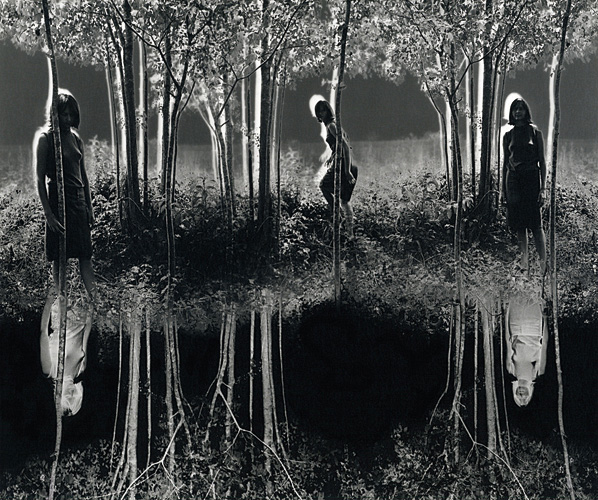
How different from—and yet, in other ways, how similar it is to my “Under the Bridge.” As a naturalist, I can only sigh and say to myself: Look how urban you have become!
Comment: A few months after this post was published, this photograph, Under the Bridge, triggered a full project, Challenges in the Wind.
Recent Comments